
Customer questions set the direction
On Tuesday, we brought our customers together at Advania UK’s London office for a customer session with our British colleagues and Broadcom.
That was also the purpose of the trip: to take a closer look at the roadmap and the technology, but above all to discuss what these developments mean for our customers. We wanted to understand their needs and identify together how we can support the continued development of their platforms.
From Broadcom’s roadmap to the customer’s reality
During the customer session, we heard three different perspectives that together gave us a clear picture of the journey ahead.
Lee Dilworth from Broadcom gave us an insight into the roadmap for VMware Cloud Foundation and developments in VCF 9. Topics included lifecycle management, covering how the platform is managed throughout its life, capacity optimisation, NVMe Tiering, resilience, Kubernetes and Infrastructure as Code, where infrastructure is configured and managed through code. The message “Innovation is the Heart of VMware” set the tone for much of what we would later hear at Explore.
Rutger Blom from Advania then took us from roadmap to reality, showing how the journey from vSphere to VCF and private cloud can be approached step by step. An important shift is moving from traditional infrastructure delivery towards self-service, automation and a more service-based platform.
Anders Nilsson from Advania took the discussion further into Kubernetes, Tanzu, artificial intelligence (AI) and security. As AI creates new opportunities while also changing the threat landscape, a modern application platform with integrated security becomes increasingly important.
This created a clear thread running through the day:
Where is the platform heading? How do we get there from today’s environment? And what new opportunities do we need to prepare for?
Private cloud, AI and security in focus at Explore
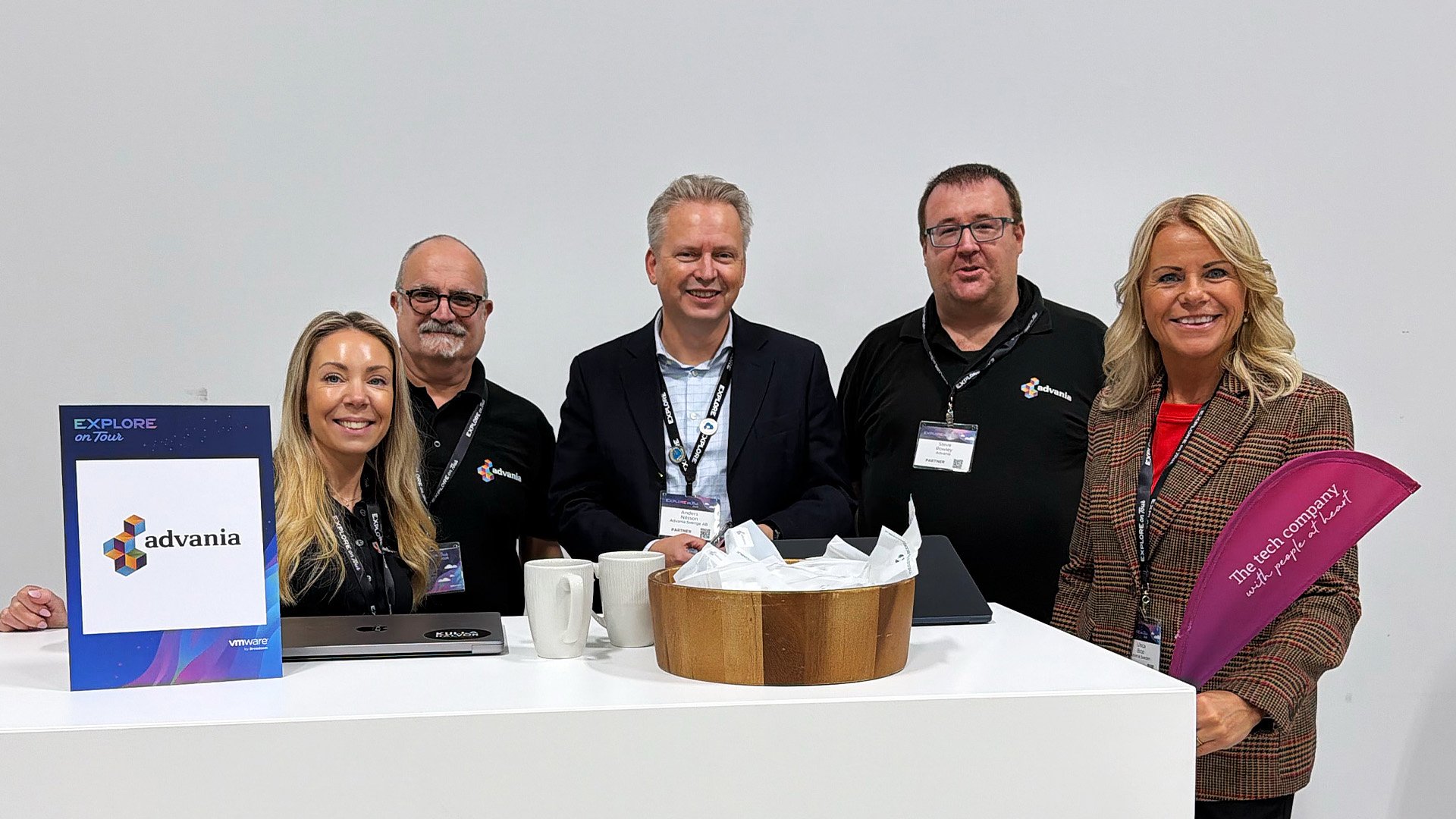
The following day, we continued to VMware Explore on Tour. Several of the discussions from our own customer session carried straight onto the main stage.
Private cloud, AI, modern applications and security were recurring themes. VMware Cloud Foundation brings together support for virtual machines, containers, Kubernetes, automation and AI on a shared platform.
Through automation and self-service, teams can access resources within common policies and guardrails. This changes both how infrastructure is delivered and how it is consumed.
From individual requests to reusable services
An important part of this development concerns how infrastructure is consumed.
Rather than every request passing through several infrastructure, networking and security teams, a modern private cloud model can offer self-service within predefined policies and guardrails.
Virtual private networking environments, standardised virtual machine configurations and images, and storage policies then become building blocks in an automated service.
One phrase from our own session summed this up particularly well:
“The value is not the first VM. It is the tenth team.”
Once the service has been designed, automated and tested, the same model can be reused by the next team. That is when a platform approach starts to deliver real scalability.
More capacity does not always mean more servers
Another area that attracted considerable interest was NVMe Memory Tiering.
As demand for compute and memory grows, making better use of existing infrastructure becomes even more important.
NVMe, Non-Volatile Memory Express, is a technology for fast access to storage. With Memory Tiering, these storage devices can be used as an additional memory tier alongside a server’s RAM. This can make it possible to run more virtual machines on the same server.
The outcome depends on the environment, applications and performance requirements. Even so, NVMe Memory Tiering is a concrete example of how new functionality can help improve infrastructure utilisation and create room for the platform to develop further.
AI moves into the private cloud
AI was, of course, one of the hottest topics at Explore.
Broadcom’s vision is that AI should not have to become another separate infrastructure silo. VCF is evolving to support traditional applications, Kubernetes and AI on the same platform.
It is not just about graphics processing unit (GPU) capacity. It is about data, models, Kubernetes, automation, governance, security and costs, and choosing the right model and infrastructure for each use case.
Tanzu also has an interesting role here. Kubernetes is used to run and manage containerised applications, while the discussions around Tanzu took us further towards modern applications and a more developer-oriented platform.
Security must keep pace
Developments in AI also place new demands on security.
AI can help organisations move faster, but the same technology can be used to find and exploit vulnerabilities. This changes the requirements for updates, segmentation, and the protection of applications and infrastructure.
At Explore, we therefore saw a strong focus on security close to the platform. VMware vDefend offers capabilities including microsegmentation, which restricts traffic between different parts of an environment. VMware HyperArmor focuses protection on the hypervisor, the software layer that runs virtual machines.
For me, this reinforces one of the most important messages from London:
Private cloud, AI, application modernisation and security need to be seen as parts of the same platform strategy.
Stronger together, across borders too
Holding the customer session together with Advania UK demonstrated the strength of the collaboration between our countries.
For our customers, this means we can combine local presence and an understanding of their organisations with specialist expertise from more parts of Advania. It allows us to address a wider range of needs as platforms become more complex and several areas of expertise need to work together.
From innovation to business value
After a few intensive days in London, my main takeaway is that there are many opportunities, but not every customer needs to take the same steps at the same time.
For some, the next step is to optimise their existing VMware environment. For others, it is automation and self-service. Others want to start working with Kubernetes and Tanzu, strengthen their security architecture or understand how to prepare their platform for AI.
Would you like to hear more about what we brought back from London, or discuss what developments in VMware Cloud Foundation could mean for your organisation? Please get in touch with me or one of our VMware experts.